
When you start developing your first clothing collection, you quickly run into three terms that may seem like the same thing: tech pack, measurement chart, and digital pattern. They do not mean the same thing and using them interchangeably is one of the easiest ways to end up with a garment that does not turn out how you imagined.
The good news is that the difference between them is straightforward once someone explains it clearly. And understanding it properly will save you time, money, and several unnecessary rounds of sampling further down the line.
Here is an explanation of what each one is, what it does, and how they fit together.
What Is a Tech Pack?
A tech pack, short for technical package, is the complete document that tells a manufacturer everything they need to know to produce your garment correctly. If your design is a meal, the tech pack is the ingredients list and recipe.
A complete tech pack includes:
• Flat sketches or CAD drawings showing your design front and back (also the side view where required)
• Fabric specifications- composition, weight, and finish
• Trim details, zips, buttons, drawcords, labels
• Construction instructions, stitch types, seam finishes, and construction directions
• Colourways with exact Pantone references so colour is never left to interpretation
• Artwork and print placement
• A bill of materials (BOM) listing every component in the garment
• Labelling and packaging instructions

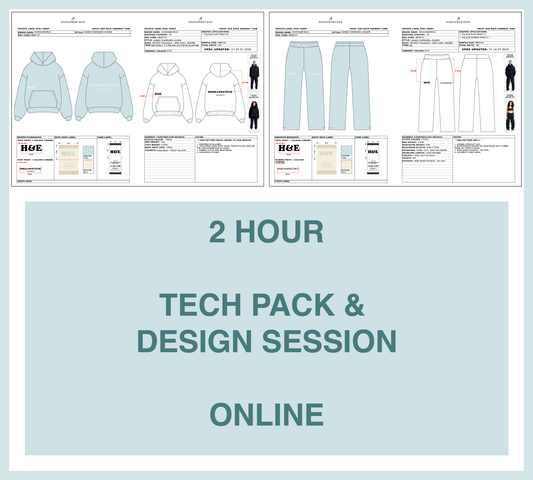
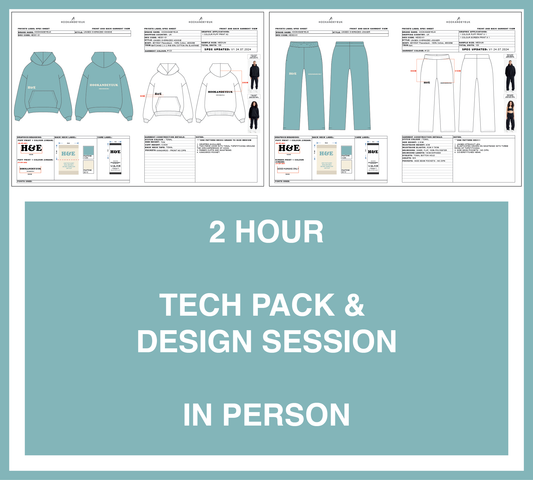
See an example of a tech pack above. The point of a tech pack is to remove ambiguity. A factory should never have to guess what you meant; every decision is documented, so what comes off the production line matches what you intended.
The line drawings in a tech pack are usually created in Adobe Illustrator, the industry-standard software for garment CAD work, while measurement charts are typically built in Excel. You do not need to know this software yourself, but it is worth understanding that a professional tech pack is a technical document, that is put together by a specialist that has fabric and construction knowledge. It’s not a mood board with some notes attached.
If you want an example of what is included in a tech pack before you commission your own, read our Ultimate Guide to Tech Packs for Fashion Brands.
What Is a Measurement chart?
Here is where it can get confusing. A measurement chart also referred to as a spec sheet is a separate document (usually produced on Excel) it works alongside a tech pack.
The measurement chart focuses on one specific job: measurements and fit. It contains:
• Measurement points - Here’s an example of the measurement points a t-shirt will include:
Length (High Neck Point to Hem)
Shoulder Point to Point,
½ Chest (2.5cm under armpit)
½ Hem, Sleeve Length
½ Bicep, ½ Sleeve Cuff
Neck Point to Point etc
• Tolerances: the acceptable variation allowed on each measurement during production
• Graded sizes- every measurement worked out across your full size range
See an example of a measurement chart below (the actual measurements are blurred). This chart does not show the allowable tolerances as Hook and Eye UK already have pre-set tolerance agreements with our factories.

The measurement chart’s purpose is consistency. When a factory produces hundreds or thousands of units, the measurement chart is what ensures a size medium in the first box matches a size medium in the last one, within agreed limits.
This is the most important thing to understand: a measurement chart on its own is not enough to manufacture a garment. It tells a factory the numbers, but not the construction, the fabric, the trims, or the finish. People who think a measurement chart can replace a full tech pack tend to find out the hard way that it cannot. It is a vital part of the package, but only a part.
What Is a Digital Pattern (And Why Does It Matter)?
A digital pattern takes a significant step beyond a measurement chart. It is a computerised version of the pattern pieces that make up your garment, the precise shapes that get cut from fabric and sewn together. See an example below.

Digital patterns are created in specialist pattern making software. There are several options used across the industry, including CLO 3D, Optitex, and Gerber.
The distinction that matters is a measurement chart gives you numbers. A digital pattern gives you shapes. And shapes are what a factory actually cuts from.
That difference has real consequences for your production:
• The pattern pieces are cut-ready, not just reference figures a factory has to interpret
• The factory can use the digital file directly for cutting and grading, which reduces error
• Fit issues can often be caught and resolved in the pattern making process, before sampling saving additional sampling rounds
• Fabric is used more efficiently, which means less waste and lower cost
The simplest way to hold the difference in your head: a measurement chart tells you what size something should be. A digital pattern is a 2D, true to size blueprint of the garment.
How They Work Together
Once you understand what each one does, the way they fit together becomes clear. The tech pack is the overall instruction manual. The measurement chart governs measurements and tolerances. The digital pattern provides the physical blueprint the factory cuts and sews from.
How these are sequenced makes a real difference to how smoothly your sampling goes, and this is where our own process differs from a lot of providers.
At Hook and Eye UK, we combine a tech pack with a sample size digital pattern and measurement chart for the sampling stage. That means the very first sample is made from proper cut-ready pattern pieces rather than a factory's interpretation of a measurement chart. Once your sample is approved, we then create a full measurement chart for size grading and sewing tolerances across your range.
Because the sample is built from an engineered pattern from the outset, this approach typically gets us to sample approval in a single round, rather than the multiple revision cycles that are common when a factory is working from measurements alone. Fewer sampling rounds means lower cost and a faster route to production.
Quick Reference:
Here is the difference in one view, worth saving for later:
|
Document |
What it does |
Explanation |
|
Tech pack |
The complete instruction manual for your garment — line drawings, fabrics, trims, construction, colourways, labelling, and the bill of materials. |
Everything the factory needs to make your product. |
|
Measurement chart |
A document that has measurement points, tolerances, and graded sizing across your size range. |
The measurements and fit rules. |
|
Digital pattern |
A computerised set of the actual garment pattern pieces, built to exact shape and proportion and ready for the factory to cut and grade from directly. |
The physical blueprint for cutting and sewing. |
Final Thoughts
Getting these three documents right before you approach a manufacturer is one of the single biggest factors in how smoothly your production runs. The brands that struggle with endless sampling rounds and disappointing results are almost always the ones that went to a factory underprepared, with just a measurement chart where a full tech pack was also needed, or a digital pattern with no accompanying measurement chart and tech pack.
Get the documentation right first, and everything downstream becomes easier, cheaper, and more predictable.
It is also worth understanding what this stage typically involves before you budget for it; our guide to tech pack costs breaks down what goes into the pricing.
If you want your garment developed properly from the start, with a tech pack, digital pattern, and grading handled by a UK team that does this every day, book a tech pack and design session with us, and we will take you through the whole process.
How Hook and Eye UK Can Help
We build complete, factory-ready tech packs and digital patterns for every level of clothing brand, from first-time founders to established labels launching new lines.
In a tech pack and design session with us, our designer can:
• Create your full tech pack, including flat drawings, fabric and trim specifications
• Provide garment construction advice and solutions
• Guide fabric and trim selection from our 600+ sample library
• Design logo and packaging
Book a Tech Pack & Design Session with Hook and Eye UK and give your first sample the best possible chance of being approved first time.
Hope you found this helpful,
H&E team :)

About the Author: Bethany is an experienced fashion designer at Hook and Eye UK, with a First-Class BA (Hons) degree in Fashion from the University of Northampton. She is the recipient of both the Fashanne East Midlands Design Award and the CORDURA Durable Design Award, recognising excellence in design and durability. Bethany began her career as a Design Assistant within the uniform industry, contributing to ranges for major brands including HSBC, EasyJet and Costa Coffee. She later worked as an Accessories Designer, creating licensed products for leading UK retailers such as Next, M&S and New Look. She joined Hook and Eye UK in November 2023.