
If you’re launching a fashion brand or developing a new product, your tech pack is your blueprint that turns your design vision into a manufacturable product.
But here’s the big question: how detailed should your tech pack actually be?
Too vague, and you’ll face sampling errors, delays, and unexpected costs.
Too complex, and you risk overcomplicating the process or spending unnecessary time documenting.
The goal is not to create the longest tech pack possible — it’s to create one that is clear, structured, and complete enough for a factory to follow without guesswork.
What Is a Tech Pack?
Before diving into how detailed your tech pack should be, it’s important to understand what it includes. A tech pack is not just a drawing or a measurement sheet — it’s a full instruction manual for your garment.
A tech pack (technical package) is a document that communicates everything a manufacturer needs to produce your product accurately.
Typically created in tools like:
- Adobe Illustrator
- Excel (for measurement charts)
- PLM systems
A tech pack includes:
- Technical Illustrations (flats)
- Construction details
- Bill of materials (BOM)
- Label design (inner and outer)
- Graphic application details
- Colourways
- Construction notes
- Sampling information
- Style and graphic coding
Think of it as the bridge between creativity and production.
So… How Detailed Should It Be?
This is where most brands get stuck. There’s often a misconception that more pages automatically mean a better tech pack — but that’s not the case. What matters is whether the information is clear and complete.
Your tech pack should be detailed enough that a factory can produce your garment without asking basic clarification questions.
If a manufacturer needs to guess — whether it’s about fabric, stitching, or placement — your tech pack isn’t detailed enough.
To make this clearer, let’s break it into practical levels.
Level 1: The “Too Basic” Tech Pack (Not Enough Detail)
This level is very common with startups or first-time designers. At this stage, the focus is usually on communicating the idea visually, but not technically, which leads to gaps in production information. Like the example below, new brands often miss out vital seam detailing (see hood section) and place graphics in positions that not correct (see back graphic).

What It Usually Contains:
- Basic front/back sketch
- General fabric description (“100% cotton”)
- A few sample measurements
What’s Missing:
- Reference images
- Stitch types
- Seam finishes
- Pantone colours
- Full fabric compositions and coding
- Construction notes and annotations
- Graphic & label placement (including codes)
- Bill of Materials
Result:
- Multiple factory questions
- Incorrect samples
- Cost changes during development
This level of detail almost always leads to delays and expensive revisions.
Level 2: Production-Ready Tech Pack
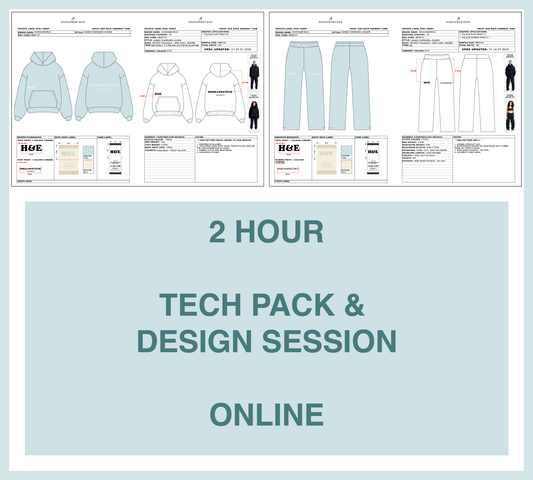
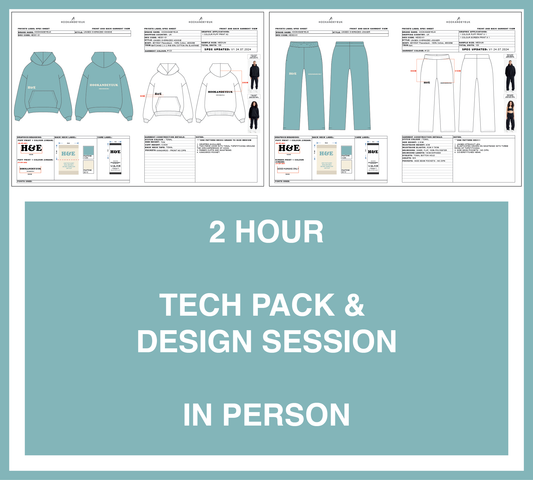
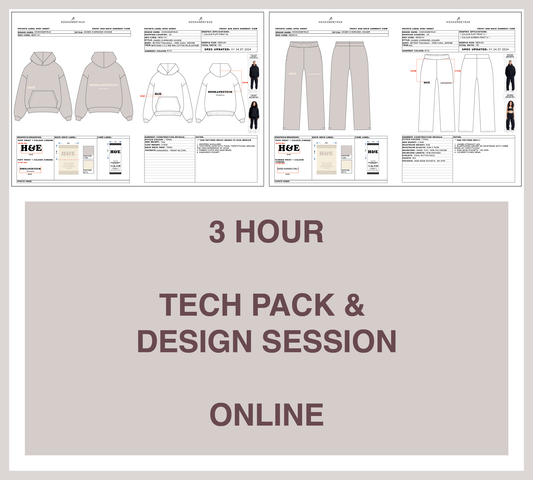
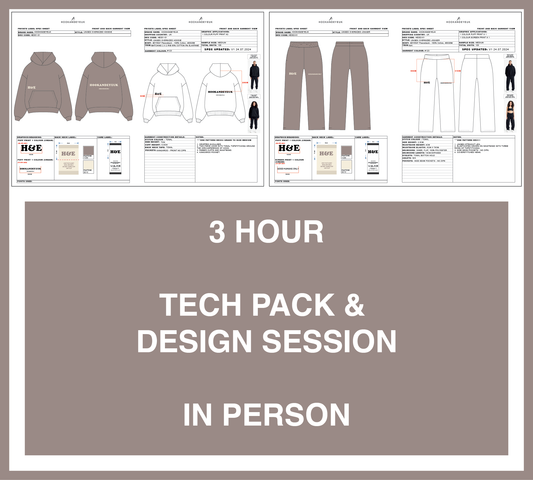
A production-ready tech pack (as seen in the title image) removes assumptions. It clearly defines every part of the garment so the factory can follow instructions without needing to interpret your design.
Each section below plays a role in building that clarity.
Colour Drawing
This section gives a visual representation of your final garment. It helps align everyone — from designer to manufacturer — on how the product should look before focusing on technical construction.
- Front, back (and side if needed)
- Clean vector drawings
- Full colour visualisation
Technical Flats
While colour drawings show appearance, technical flats show construction. These are the drawings factories rely on most when constructing a garment.
- Front, back (and side if needed)
- Clean black-and-white vector drawings
- Construction annotations/diagrams
- Photographic examples
Construction Details
This is where you explain exactly how the garment is made. Without this section, factories will default to their own methods — which may not match your expectations.
Specify:
- Stitch type (e.g., 5-thread coverstitch)
- Neck binding method
- Inner construction (elastic, facings, lining, removable bra cups, etc.)
- Hem type
- Pockets (type, placement + size)
Sampling / Manufacturing Details
This section provides the context needed for both development and production. It ensures the factory understands sizing, quantities, and overall requirements from the start.
Include:
- Base pattern size
- Fit reference to be used (plus a visual)
- Sample size
- Size range for production
- Bulk production quantity
- Shipping country
Bill of Materials (BOM)
The BOM is one of the most important sections in your tech pack. It lists every component required to build the garment, ensuring nothing is left open to interpretation.
Include:
- Fabrics (type, composition, weight, colour)
- Trims such as zips, buttons, drawcords, eyelets, aglets (size, material, colour)
For example, instead of:
- “Heavy cotton”
Write:
- (Fabric code if you have one) - Single Jersey - 100% Organic Cotton - 260 GSM
Branding & Label Placement
Branding is where small mistakes can have a big impact. This section ensures your brand identity is applied consistently across all units.
- Label dimensions
- Fold type
- Graphic application type & colour
- Graphic application size and positioning
Colourways
Colourways should never be combined into a single page. Each version of your garment needs its own tech pack and colourway code to avoid confusion during production.
- A separate tech pack and code should be created for each colourway
- Clear visuals for each version
- Accurate fabric, trim, and branding colours
How to Know If Your Tech Pack Is Detailed Enough
Before sending your tech pack, it’s important to step back and review it objectively. This helps you identify any gaps before they become production issues.
Ask yourself:
- Could someone unfamiliar with this product recreate it?
- Are there any “assumptions” left for the factory?
- Have I specified every visible detail?
- Would this document protect me in a production dispute?
If the answer to any of these is “no,” you need to add more detail.
Real-World Example: Minimal vs Detailed
Sometimes, the difference between a weak and strong tech pack comes down to how specific your instructions are.
Minimal Annotation:
- Logo on left chest
Detailed Version:
- 6 cm width screen print, plastisol ink, Pantone Black C, centred 8 cm below HSP on size M. Adjust proportionally for graded sizes.
The difference is simple — one leaves room for interpretation, the other doesn’t.
The Ultimate Tech Pack Checklist
Before sending your tech pack to a factory, use this checklist to ensure nothing important has been missed. Click the link below to download your checklist now.
DOWNLOAD HERE – The Ultimate Tech Pack Checklist
The Hidden Cost of Under-Detailing
At first, a simple tech pack might feel quicker to create. But in reality, missing details creates problems later in the process.
It often leads to:
- Misunderstanding
- Extra sampling rounds
- Production delays
- Quality issues
- Damaged supplier relationships
A detailed tech pack may take more time upfront — but it saves significantly more time and money later.
How Hook and Eye UK Can Help
At Hook and Eye UK, we create detailed, production-ready tech packs that remove ambiguity and streamline the development process.
We support you with:
- Professional tech pack creation
- Fabric and trim specification
- Sampling and development guidance
- Direct factory communication
Book a Tech Pack & Design Session with Hook and Eye UK and ensure your garments are built correctly from the very start.
Hope you found this helpful,
H&E team :)

About the Author: Bethany is an experienced fashion designer at Hook and Eye UK, with a First-Class BA (Hons) degree in Fashion from the University of Northampton. She is the recipient of both the Fashanne East Midlands Design Award and the CORDURA Durable Design Award, recognising excellence in design and durability. Bethany began her career as a Design Assistant within the uniform industry, contributing to ranges for major brands including HSBC, EasyJet and Costa Coffee. She later worked as an Accessories Designer, creating licensed products for leading UK retailers such as Next, M&S and New Look. She joined Hook and Eye UK in November 2023.