
Behind every well-made hoodie is a carefully structured tech pack that defines how each component is built, assembled, and finished. From sleeve panels and rib trims to hood type and pocket placement, even small details can significantly affect fit, cost, and production quality.
This is why a detailed hoodie tech pack is essential. It removes guesswork, ensures consistency, and allows factories to execute your design exactly as intended.
In this guide, we’ll break down each section of a hoodie tech pack — so you understand not just what to include, but why it matters.
Why Hoodies Require Extra Detail in a Tech Pack
Compared to a basic t-shirt, hoodies are more complex garments. They involve multiple components working together, each of which needs to be clearly defined.
A standard hoodie may include:
- Multiple panels
- Ribbed cuffs and waistband
- A hood (often double-layered and possibly panelled)
- Drawcords, eyelets and aglets
- Kangaroo pockets or alternative pocket styles
- Visible topstitching
- Centre front zip
If any of these elements are unclear or missing from your tech pack, factories will be forced to make assumptions — which often leads to sampling errors and delays.
Section 1: Technical Flats — Define Every Panel
The tech pack should always begin with clear technical drawings, often referred to as “flats.” These are not fashion sketches — they are precise, functional drawings that factories use as a visual blueprint.
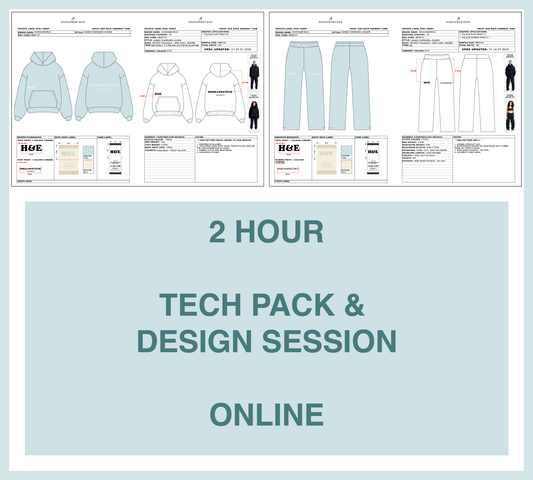
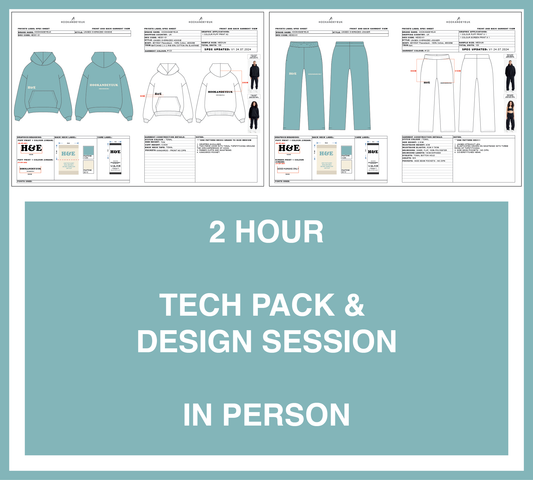
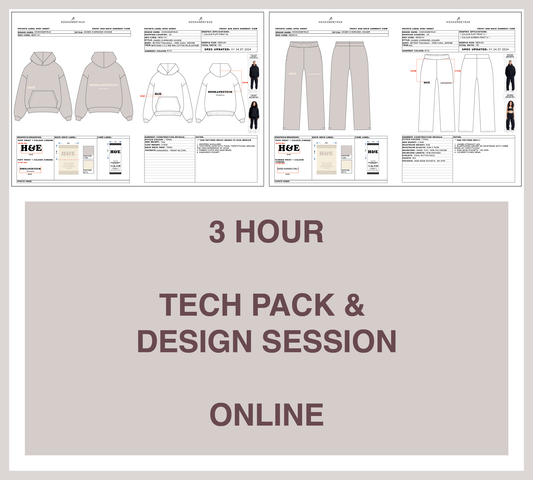
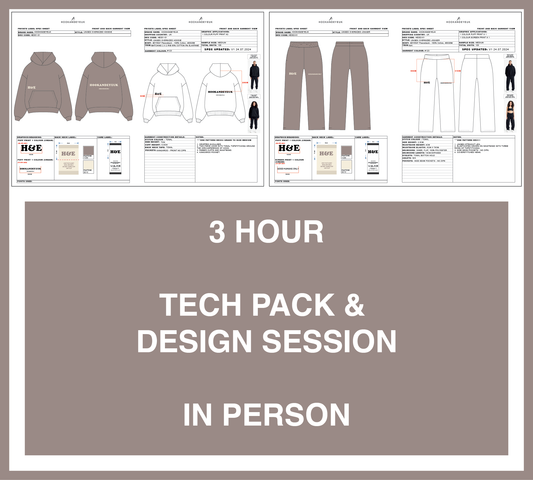
You should include both a coloured version (for design clarity) and a black-and-white version (for technical accuracy). See the top two pages in the title images to understand how details a technical line drawing or ‘flat’ should be.
Must include:
- Front view
- Back view
- Side view (if panelling or shape is unique)
- Close-up detail views (hood construction, pocket, ribbing)
Factories rely heavily on these drawings. If a seam, stitch, or panel is not shown, it is often assumed not to exist — which can result in incorrect construction.
Section 2: Hoodie Structure Breakdown
It’s vital to clearly show in your line drawings overall construction and panelling details such as:
Body construction:
- Cropped or standard length?
- Straight or curved hem?
Sleeve type:
- Set-in
- Raglan
- Drop shoulder
- Panelled sleeve
Hood type:
- Is it a one-piece, two-piece, or three-piece hood?
- Single-layered or double-layered?
- Overlapping neckline or standard join?
These decisions directly impact how the garment fits and how it sits on the body. For example, a three-piece hood typically creates a more curved shape, while a one-piece hood may feel softer but less defined.
Section 3: Fabric Specifications
Fabric is one of the most important elements in hoodie development. It defines the weight, structure, and overall feel of the garment.
Simply writing “100% cotton” is not enough. Factories need detailed specifications to source the correct material.
Instead of writing:
- 100% cotton
Write:
#2013 French Terry (Loopback) – 100% Cotton, 420GSM
The above includes (in order):
- Fabric code (if you have one)
- Fabric type
- Knit type (loopback, brushed fleece, or interlock)
- Composition
- GSM
This is not included above but you may also consider:
- Brushing details (one-sided or two-sided brushed)
- Wash treatment
The more precise your fabric description, the closer your sample will match your expectations. See the bottom right B.O.M (Bill of Materials) section in the title image to see how fabric is specified within an industry standard tech pack.
Section 4: Rib Trim Specifications
Rib trims are used for cuffs and waistbands, and they play a key role in both fit and durability. Poorly specified ribbing can lead to garments that stretch out or lose shape over time.
Specify:
- Rib ratio (2x2, 1x1, etc.)
- Cuff height
- Waistband height
The rib ratio affects both the visual appearance and elasticity of the garment, so it should never be left to assumption. Again, see the bottom right B.O.M (Bill of Materials) section in the title image to see how rib fabric is specified within an industry standard tech pack.
Section 5: Pocket Details & Placement
The pocket is one of the most recognisable features of a hoodie — and one of the most common areas for errors.
A standard kangaroo pocket may seem straightforward, but small changes in placement or size can significantly affect the look and usability.
Specify:
- Pocket style (Welt pocket with or without flap, kangaroo pocket, side or zipped pockets)
- Width
- Height
- Opening width
- Angle
- Pocket opening shape (curved or straight)
- Topstitch detail
- Reinforcement (bar tacks)
- Position (especially if raised above the waistband)
Clear pocket specifications ensure consistency across samples and bulk production. On your tech pack is usually outlined in your ‘technical detail’ line drawing – see top left of the title image.
Section 6: Stitching & Construction Details
Stitching is where your garment’s quality becomes visible. It affects both durability and overall aesthetic.
Factories need to know exactly which stitch types to use and where.
Common hoodie stitches:
- Single line topstitch
- 2-needle coverstitch
- Twin-needle stitching
- Exposed coverstitch
- Bartacks (for reinforcement)
If stitching is not specified, factories will default to standard methods — which may not align with your design or quality expectations. Usually outlined in your ‘construction details’ section of your tech pack – see bottom right of the title image.
Section 7: Trims
Trims add both functionality and visual identity to your hoodie. These small components can elevate a garment — or, if poorly specified, reduce its perceived quality.
Drawcord, eyelets & aglets
Include:
- Cord material (cotton, polyester, elastic, waxed)
- Diameter (e.g., 4mm)
- Exposed length
- Eyelet type (metal or embroidered)
- Eyelet colour/material
- Cord end finish (metal, plastic, rubber, knotted, etc.)
Other hardware
Other components might include:
- Zips (pockets or centre front)
- Press studs on the hood
Each trim should be clearly defined to avoid inconsistencies. This is most commonly presented in the BOM section of your tech pack – see the bottom right section of the title image for an example.
Section 8: Branding & Labelling
Branding is what transforms a garment into a recognisable product. This section ensures your brand identity is applied consistently.
Graphic applications
- Size of the graphic
- Position
- Application method (screen print, puff print, embroidery)
- Ink type (water-based, plastisol, reactive)
- Colour references (Pantone or thread colour)
Labels
- Back neck label size
- Fold type (end fold, loop fold)
- Placement
- Fabric type (satin, damask, cotton)
- Colour references
Care label
- Fibre content
- Wash instructions
- Country of origin
- Placement
Clear branding instructions ensure consistency across production runs. These would usually sit on the same page as your BOM – see bottom right of the title image for an example.
Section 7: Fit Reference
The most import information on your tech pack is where the fit of your garment is coming from. This is usually either an existing garment that you love the overall fit of (with a few tweaks) or many factories may offer pre-developed garments that you can manipulate. Take a look at our pre-developed garment collection here.
Whichever option you choose it’s vital that your fit reference is included in your tech pack. See an example in top right page of the title image.
Hoodie Tech Pack Checklist
Before sending your tech pack to a factory, it’s important to review everything carefully.
Download your free checklist here!
This checklist helps ensure nothing critical has been missed.
Final Thoughts: Detail = Control
A hoodie may appear simple, but manufacturing one without a detailed tech pack introduces unnecessary risk. The fewer issues you will face during sampling and production.
A complete hoodie tech pack doesn’t just communicate your design — it gives you control over quality, timelines, and costs.
How Hook and Eye UK Can Help
At Hook and Eye UK, we specialise in building detailed, production-ready tech packs for garments like hoodies — ensuring every component is clearly defined before sampling begins.
Our team supports you with:
- Professional tech pack creation
- Fabric and trim specification
- Pattern development and fit guidance
- Direct factory communication
Book a Tech Pack and Design Session with Hook and Eye UK and let our team help you develop hoodies that are not just well-designed but built correctly for production from the start.
Hope you found this helpful,
H&E team :)

About the Author: Bethany is an experienced fashion designer at Hook and Eye UK, with a First-Class BA (Hons) degree in Fashion from the University of Northampton. She is the recipient of both the Fashanne East Midlands Design Award and the CORDURA Durable Design Award, recognising excellence in design and durability. Bethany began her career as a Design Assistant within the uniform industry, contributing to ranges for major brands including HSBC, EasyJet and Costa Coffee. She later worked as an Accessories Designer, creating licensed products for leading UK retailers such as Next, M&S and New Look. She joined Hook and Eye UK in November 2023.